'%3e%3cpath%20d='M30.3398%2014.9472C33.3988%2013.3691%2035.4903%2010.1783%2035.4903%206.49914C35.4903%206.34833%2035.4868%206.19834%2035.4798%206.04924C35.7675%206.01033%2036.0611%205.99023%2036.3594%205.99023C39.9493%205.99023%2042.8594%208.90038%2042.8594%2012.4902C42.8594%2013.3582%2042.6893%2014.1865%2042.3806%2014.9435C41.7589%2014.8076%2041.1132%2014.7361%2040.4508%2014.7361C37.55%2014.7361%2034.9697%2016.1084%2033.3238%2018.2393C31.9818%2017.5292%2030.9183%2016.363%2030.3398%2014.9472Z'%20fill='white'/%3e%3cpath%20d='M22.9659%2012.2546C23.4413%2011.1233%2023.7041%209.88067%2023.7041%208.57666C23.7041%206.08774%2022.7469%203.82238%2021.1807%202.12856C22.3697%200.820907%2024.0846%200%2025.9912%200C29.581%200%2032.4912%202.91015%2032.4912%206.5C32.4912%2010.0899%2029.581%2013%2025.9912%2013C24.8989%2013%2023.8695%2012.7306%2022.9659%2012.2546Z'%20fill='white'/%3e%3cpath%20d='M15.577%2014.9307C18.5071%2014.3003%2020.7032%2011.6947%2020.7032%208.57617C20.7032%204.98632%2017.7931%202.07617%2014.2032%202.07617C10.6975%202.07617%207.84%204.85154%207.70801%208.32496C11.4366%208.79732%2014.4913%2011.4309%2015.577%2014.9307Z'%20fill='white'/%3e%3cpath%20d='M11.6417%2021.7296C12.4944%2020.63%2013.002%2019.2493%2013.002%2017.75C13.002%2014.1601%2010.0918%2011.25%206.50195%2011.25C2.9121%2011.25%200.00195312%2014.1601%200.00195312%2017.75C0.00195312%2019.2483%200.508897%2020.6282%201.36062%2021.7275C2.84207%2020.7729%204.60611%2020.219%206.49951%2020.219C8.39431%2020.219%2010.1595%2020.7737%2011.6417%2021.7296Z'%20fill='white'/%3e%3cpath%20d='M12.9953%2029.4699C9.26664%2029.9413%206.21154%2032.5738%205.12472%2036.073C2.1954%2035.442%200%2032.8366%200%2029.7188C0%2026.1288%202.91015%2023.2188%206.5%2023.2188C10.0065%2023.2188%2012.8645%2025.9954%2012.9953%2029.4699Z'%20fill='white'/%3e%3cpath%20d='M19.0102%2034.5236C17.8212%2033.2157%2016.1061%2032.3945%2014.1992%2032.3945C10.6094%2032.3945%207.69922%2035.3047%207.69922%2038.8945C7.69922%2042.4844%2010.6094%2045.3945%2014.1992%2045.3945C15.29%2045.3945%2016.3179%2045.1259%2017.2206%2044.6511C16.7458%2043.5205%2016.4834%2042.2786%2016.4834%2040.9755C16.4834%2038.4847%2017.4419%2036.2179%2019.0102%2034.5236Z'%20fill='white'/%3e%3cpath%20d='M26.8652%2034.534C26.5765%2034.4949%2026.2818%2034.4746%2025.9824%2034.4746C22.3926%2034.4746%2019.4824%2037.3848%2019.4824%2040.9746C19.4824%2044.5645%2022.3926%2047.4746%2025.9824%2047.4746C28.7019%2047.4746%2031.0313%2045.8046%2032.001%2043.4341C28.9442%2041.8553%2026.8545%2038.6658%2026.8545%2034.9882C26.8545%2034.8359%2026.8581%2034.6845%2026.8652%2034.534Z'%20fill='white'/%3e%3cpath%20d='M46.9512%2023.7363C46.9512%2027.3262%2044.041%2030.2363%2040.4512%2030.2363C36.8613%2030.2363%2033.9512%2027.3262%2033.9512%2023.7363C33.9512%2020.1465%2036.8613%2017.2363%2040.4512%2017.2363C44.041%2017.2363%2046.9512%2020.1465%2046.9512%2023.7363Z'%20fill='white'/%3e%3cpath%20d='M33.3266%2029.2363C31.2624%2030.3254%2029.8555%2032.4929%2029.8555%2034.989C29.8555%2038.5788%2032.7656%2041.489%2036.3555%2041.489C39.9453%2041.489%2042.8555%2038.5788%2042.8555%2034.989C42.8555%2034.1193%2042.6847%2033.2894%2042.3747%2032.5312C41.7551%2032.6661%2041.1117%2032.7371%2040.4517%2032.7371C37.552%2032.7371%2034.9726%2031.3658%2033.3266%2029.2363Z'%20fill='white'/%3e%3c/g%3e%3cdefs%3e%3cclipPath%20id='clip0_942_164'%3e%3crect%20width='47'%20height='48'%20fill='white'/%3e%3c/clipPath%3e%3c/defs%3e%3c/svg%3e)
Most of Your Customers Would Come Back. You Just Never Message Them.
Repeat business isn't a loyalty problem, it's a follow-up problem. Four WhatsApp messages that bring MENA customers back, with Arabic + English templates.
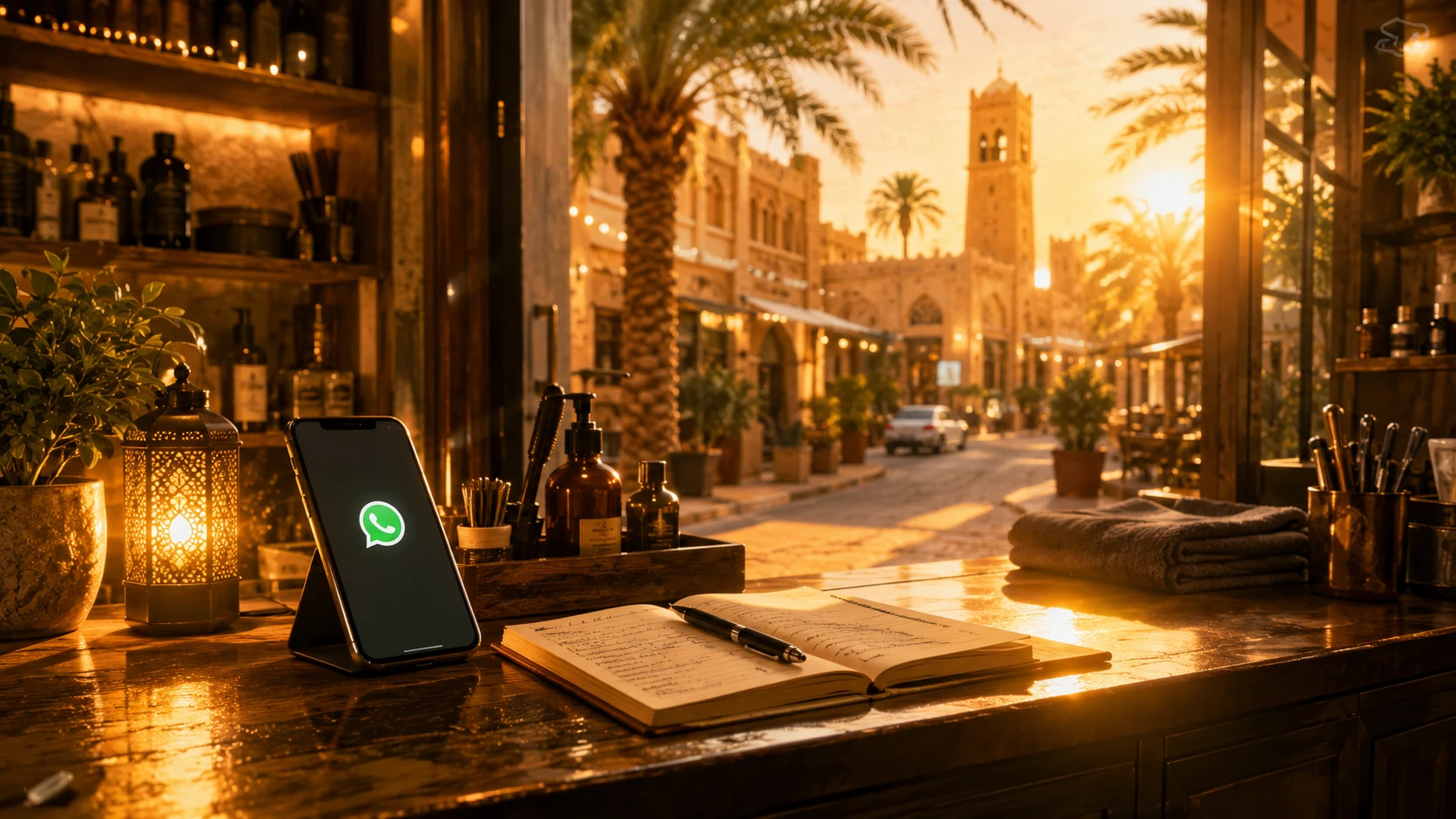
Here's a number most shop owners never calculate: how many first-time customers they never see again. It's usually most of them. And the reason is almost never that they were unhappy. It's that nothing reminded them to return.
Loyalty has little to do with it. People drift off when nothing pulls them back, and pulling them back costs far less than chasing someone new.
The fix is WhatsApp, not as a broadcast megaphone but as four specific messages sent at four specific moments. This is the whole playbook, templates included, in Arabic and English.
Why WhatsApp beats SMS for follow-up in MENA
Because in Saudi Arabia a promotional SMS has to announce itself as one. The rules require marketing texts to go out from a registered sender name classified as "promotional," so the moment your message lands it reads as an ad, and most people clear it without reading. A WhatsApp message carries none of that baggage: it comes from a number the customer already knows, so it looks like a person reaching out, not a campaign.
That difference decides whether anyone acts. An SMS that's visibly marketing, with a link to tap, rarely gets the tap. A WhatsApp note that mentions someone's last visit and asks one simple question gets a reply, because it feels like you, not a broadcast. Same customer, same offer, completely different read.
The catch isn't the channel. It's consistency. Most owners follow up when they happen to remember, which means most customers hear from them exactly never. Turn that into a small routine and you've already beaten almost everyone on your street.
What are the four follow-up moments that win repeat business?
There are exactly four: just after a customer visits, just before they're due again, after they've gone quiet, and right when they're happy enough to tell a friend. Get those four right and you recover most of the repeat business you're currently leaving on the table.
1. The thank-you (within 24 hours)
Quick, warm, no ask. It makes the visit stick and opens the door.
EN: "Thank you for visiting [Business], [Name]! Hope you loved your [service]. Reply here any time you need us. 🙏"
AR: "شكراً لزيارتك [الاسم]! نتمنى أنك سعيد بـ[الخدمة]. تواصل معنا في أي وقت تحتاجنا. 🙏"
2. The re-booking nudge (timed to the service)
Catch them right when they're naturally due back: a cut at four weeks, a car service at its interval, a dental check at six months.
EN: "Hi [Name], it's been about [4 weeks] since your last [haircut]. Want me to hold a spot this week? Just reply with a day that works."
AR: "أهلاً [الاسم]، مرّ حوالي [٤ أسابيع] على آخر [قصة شعر]. أحجز لك موعد هذا الأسبوع؟ رد لي باليوم المناسب."
3. The win-back (for customers gone quiet)
A reason to return for the ones who drifted.
EN: "We've missed you at [Business], [Name]! It's been a while. Here's [10% off / a free add-on] on your next visit this month. Want to book?"
AR: "اشتقنا لك في [الاسم]! غبت عنا فترة، ولك [خصم ١٠٪ / إضافة مجانية] على زيارتك القادمة هذا الشهر. تحب تحجز؟"
4. The referral or review ask (after a happy visit)
When someone's clearly pleased, ask once, politely and specifically.
EN: "So glad you enjoyed your visit, [Name]! If you know someone who'd like it too, send them our way, and a quick Google review really helps a small shop like ours. ❤️"
AR: "سعداء أن الزيارة عجبتك [الاسم]! إذا تعرف أحد يستفيد، دلّه علينا، وتقييم سريع على Google يساعد محل صغير مثلنا كثير. ❤️"
How do I follow up without becoming annoying?
Respect three things and follow-up stays welcome: permission, timing, and frequency. Cross any of them and you've become the business people mute.
- Only message customers who opted in. Someone who booked or bought from you has a reason to hear from you. A number you scraped does not.
- Tie every message to a moment, not a calendar blast. A re-booking nudge timed to the service feels thoughtful. "We have offers!" sent to everyone at once feels like spam, because it is.
- Cap it. For most local businesses, more than two or three messages a month is too many. Better timing beats more messages, every time.
A small thing that helps a lot: keep simple labels like "due to re-book," "lapsed," and "VIP," so the right message reaches the right person instead of everyone getting everything.
Don't run this on memory
This only works if it happens without you having to remember it, which means the customer's history and the next nudge have to live somewhere other than your head. The owner running follow-up from memory reaches maybe one customer in ten. Not because they're lazy, but because nobody can hold that in their head while also running a shop.
Follow-up isn't a campaign you launch. It's a habit you keep.
That's the job a business management platform does: it keeps each customer's history, last visit, and contact details in one place, so you can see at a glance who's due for a nudge and who's gone quiet, then message them on WhatsApp without scrolling back through months of chats. The templates above work on their own. A system is just what makes sure nobody slips through.
What does a week of this actually look like?
Picture a salon in Riyadh. Saturday, it sends thank-yous to everyone who came in that week. Monday, it checks who's about four weeks past their last cut and sends re-booking nudges, and three book the same day. Wednesday, it messages five people who haven't been in for three months with a small returning-customer offer, and two come back. None of it took more than fifteen minutes a day, and it quietly filled a mid-week that's usually dead.
That's the entire trick. Not a campaign. A habit.
The takeaway
The customers you've already served are the cheapest growth you'll ever get. You just have to give them a reason to come back, at the moment they'd naturally return. Four messages, sent on time, do most of that work. The only hard part is remembering to send them.
Swarlet is a modern business management platform that keeps your customer history and follow-up in one place, so the right nudge goes out without you having to track it. Join the waitlist to be first in line when we launch, or read why your customers are asking AI for a recommendation and getting someone else's name.
Frequently asked questions
- Is it okay to message customers on WhatsApp for follow-up?
- Yes, as long as they opted in by booking or buying from you, and you keep it useful and infrequent. Don't message people who never agreed to hear from you.
- Do I need the WhatsApp Business app or the API?
- The free WhatsApp Business app is plenty for small volumes. Move to the WhatsApp Business Platform (API) when you scale up, and as of early 2026 you can run both on the same number at once.
- How often should I follow up with a customer?
- Tie messages to moments such as thank-you, re-booking, win-back, and referral rather than a fixed schedule. For most local businesses, two to three a month is a sensible ceiling.
- What should I say in a re-booking message?
- Reference their last service and the natural interval, then make booking easy: It's been about four weeks since your last haircut, want me to hold a spot this week?
- How do I keep track of who to follow up with?
- Record each customer's last visit and service, then group them by status such as due, lapsed, or VIP. A business management platform like Swarlet stores this so you're not relying on memory or scrolling through chats.